
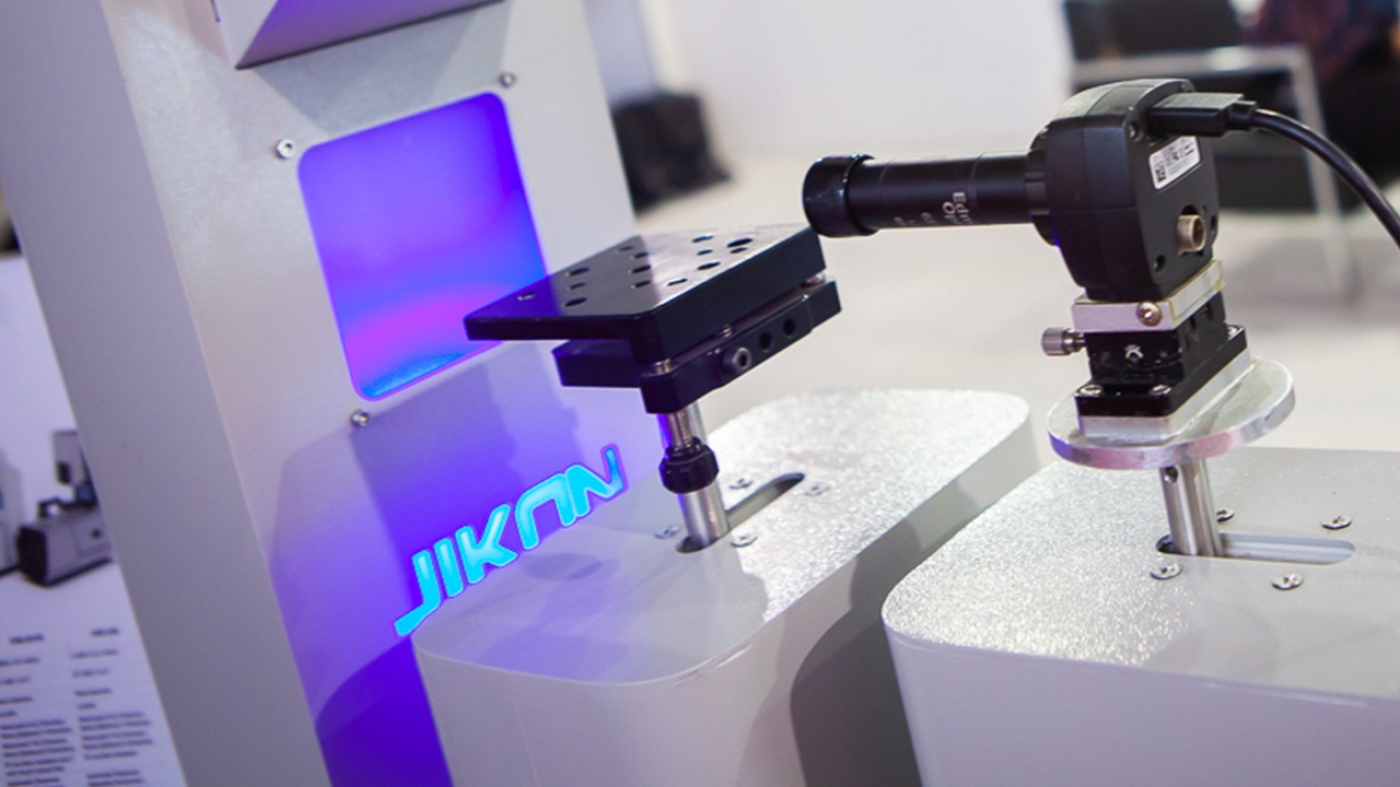
At the 16th International Nanotechnology Exhibition of Iran, one innovation drew exceptional attention: a fully Iranian contact angle and surface tension measurement system that integrates surface science with artificial intelligence. Designed and built by Nano Surface Engineering Zhikan, the device offers nanometric precision and features an AI-powered image processing module. This achievement represents a major step forward in localizing advanced laboratory equipment and enhancing Iran’s technological capabilities.
 November 16, 2025
 Industrial
The rapid growth of surface nanoengineering technologies in recent years has opened new pathways for the development of advanced materials, coatings, and smart devices. Surface behavior at the nanoscale is a key factor in the final performance of materials in fields such as paints and coatings, medicine, automotive, and high-end electronics. As a result, precise tools for characterizing surface properties, including contact angle and surface tension, play a critical role in industrial innovation and scientific research.
In this context, the development of a domestically built system that can accurately measure these parameters while leveraging artificial intelligence represents a major step toward technological self-reliance.
Today, Zhikan is recognized as an active player in the field of advanced laboratory instrumentation, but the road to the final product has been long.
Amir Bahraini, a member of the company’s Board of Directors, explains the origin of the idea: “The initial concept was proposed by a university professor on our team. After he returned from Canada, the idea of designing an innovative contact angle measurement system emerged at the Mechanical Engineering Faculty of the University of Tehran, and a young team went on to found Zhikan.”
According to Bahraini, the project’s core team was formed in 2014, and the first three years were dedicated to initial development. The company’s first commercial product entered the market in 2017. The latest version, which includes an integrated AI processing module, was launched as a development project in 2024 and reached full commercialization, along with official nanoscale certification, in 2025. This ten-year journey reflects the strong scientific and engineering foundation behind the product.
The system’s function is rooted in surface science. To simplify the concept, Bahraini says: “You have probably noticed that a water droplet spreads and stays on some surfaces but rolls off others. The first type is hydrophilic, and the second is hydrophobic.”
The contact angle is the scientific measure of this behavior.
A smaller angle indicates a more hydrophilic surface.
A larger angle indicates a more hydrophobic surface.
This parameter is crucial in many industries, including paints and coatings, automotive, oil and gas, biomaterials, medicine, and textiles, since it directly influences how surfaces interact with liquids.
Differences in surface structure at the nanoscale largely determine whether a surface behaves as hydrophilic or hydrophobic. Bahraini explains: “The nano aspect of our product relates to the science behind the phenomenon. The behavior of a droplet in contact with a surface is nanoscale in nature. A well-known example is the lotus effect, where the leaf of a lotus plant inspired the design of engineered hydrophobic surfaces.”
In this way, the Zhikan system is more than a measurement instrument. It is also a platform for research in surface nanoengineering and the development of smart, functional surfaces.
One of the most prominent features of the system is the integration of an AI processing module. In conventional systems, the user manually defines the boundary between the droplet and the surface, a sensitive step that introduces significant human error.
Bahraini explains: “By developing the software alongside the hardware, we equipped the system with image processing capabilities. The AI module now detects the surface and droplet boundary automatically and calculates the angle without operator intervention.”
This innovation leads to higher accuracy, improved repeatability of experiments, and the elimination of user-dependent variation, all of which are crucial for laboratories and industrial R&D centers.
Another distinctive feature compared with foreign competitors is the modular design. Components of the system can be upgraded, replaced, or repaired independently.
According to Bahraini: “Modularity means that if one part fails, the user only needs to replace that specific module. In addition, the AI module can be installed on earlier versions of the device. Existing users can upgrade their systems to the new model through a software and module update without replacing the entire unit.”
This approach not only reduces costs but also makes it easier for users in Iran to access the latest technology.
Contact angle measurement systems have long been produced by well-known companies such as Krüss and Biolin in Europe and Asia. Bahraini notes, however, that the Zhikan device offers comparable performance at a substantially lower price.
Foreign systems typically cost between 10,000 and 12,000 USD, while the Iranian model with equivalent functionality is offered at roughly one-half to one-third of that price.
Since 2018, more than 50 units have been sold to universities and industrial centers in Iran, and the system demonstrated strong performance even before the AI module was added. One user, who had previously worked with a foreign device at a university abroad, reported that the Iranian system was smoother and more user-friendly, with fewer software bugs.
Localization of this technology has already generated an estimated 2.5 million USD in foreign currency savings for the country. These savings arise not only from the lower purchase price but also from the elimination of customs fees, international shipping, installation costs, training, and foreign after-sales services.
With the start of exports, this figure is expected to increase significantly.
Production of the system is order-based, but manufacturing capacity is not constrained. Bahraini explains: “We build the systems according to customer orders and deliver them within about three working weeks. Because the know-how is in-house, we do not face real limits on the number of units we can produce.”
This production model is well-suited to high-end laboratory equipment and also reduces warehousing costs and sales risks.
Despite its success, the development journey has not been without challenges. Bahraini notes: “Supportive financial facilities often come with delays and lengthy procedures, which significantly reduce their real impact. In addition, importing certain sensitive optical components is difficult and time-consuming, which can slow down development and production.”
Even so, strong user adoption and satisfaction with the Iranian-made system demonstrate the resilience and potential of domestic technology development.
The export version of the system has been branded CAG100 (Contact Angle Goniometer 100). Bahraini explains: “From the beginning, we designed the export model so that it could be installed and used easily in any country, without needing to unscrew parts or make complex adjustments.”
High quality, modular architecture, and competitive pricing have together paved the way for this Iranian technology to enter international markets.
Zhikan’s contact angle measurement system is a clear example of how surface nanoengineering and artificial intelligence can be combined within Iran to create advanced industrial tools. It brings together scientific precision, industrial applicability, and software innovation in a single platform that can strengthen Iran’s position in high-tech laboratory equipment.
Key highlights of this innovation include:
A strong scientific and engineering foundation, built over more than ten years of R&D and multiple successful validation stages.
High accuracy and repeatability are enabled by AI-based image processing that removes operator bias.
Modular and upgradeable design that simplifies maintenance, upgrades, and after-sales service.
Significant foreign currency savings to date and strong potential for export revenue.
User-friendly, locally supported equipment that competes with leading global brands in both performance and reliability.
 Comments
 219119
 206783
 308619
 393790

 0
 Printable